
New Britain City Directory Collections
New Britain has a distributed city directory trail rather than one complete online run. Hartford County is the geographic setting, but no county counter replaces the New Britain Town Clerk archive and Public Library as the local starting points. FamilySearch, regional library holdings, the National Archives, and the Library of Congress fill different years. The record type also changes over time. A printed directory may list a household by surname, a telephone book may add a number, and a criss-cross volume may reverse the search from street to person. Treat the dates below as located coverage, not a promise that every intervening year exists.
| Collection | Years | Where Held | Access |
|---|---|---|---|
| Price, Lee & Co. city directory reels | 1882-83, 1883-84, 1884-85 examples; 18 reels | FamilySearch catalog and library computers | Microfilm/catalog access; confirm the reel |
| New Britain city-directory reference | 1928-1931 | National Archives guide and local research leads | Historical reference; verify the holding |
| Regional printed directory holdings | 1929-32; 1934-36; 1938; 1940; 1942-43; 1950; 1953-71; 1973; 1975-76; 1978; 1980-81; 1983-88; 1990 | Bridgeport Public Library History Center | Physical regional collection; check before travel |
| Library of Congress telephone directories | 1942-45; 1958-61; 1964/65-1966/67 | Digitized Library of Congress scans | Free page images |
| Library of Congress criss-cross directories | 1984-85 | Library of Congress guide and local shelf leads | Reverse address lookup; confirm volume access |
| New Britain Public Library local runs | Various; complete run not published online | Local History Room, microfilm, print holdings | On site or by appointment |
The important gap is the library's missing public year-by-year shelf list. No complete publisher sequence should be inferred from a catalog example or from a neighboring library's holdings. Ask staff to check the catalog, Local History Room shelves, microfilm, and the date range that matches the address. A negative catalog result can mean an off-site item, an unlisted bound volume, or a year that was never found in the inspected sources.
New Britain City Directory Room Access
The New Britain Public Library Local History Room is at 20 High Street. It is open Mondays and Wednesdays from 9 to 2 and also works by appointment. The room brings together printed directories, maps, historical records, New Britain Herald microfilm, Heritage Hub notices, the digital Herald, FamilySearch access, Burritt journals, three named scrapbooks, Rev. John Smalley writings from 1767, Burritt papers, and yearbooks beginning in 1904. Call 860-224-3155 before making a trip when a specific year or reel matters.
Access is layered. A librarian can identify a printed volume or microfilm reel, a library computer can provide the FamilySearch route, and a digital newspaper search can locate a person or street before the scan is checked. Heritage Hub notices run from 1704 to today, while the library's microfilm remains useful when OCR drops initials, punctuation, Polish names, or street abbreviations. Record the title, year, publisher, page, image, and the search term that produced the hit.
The library's local-history listing is the best place to confirm hours and collection access before using a directory. The location is a research desk, not a current resident register, so a dated entry should be paired with an official record when the question depends on ownership or a present-day address.
Open the New Britain library collection source used for this image. It shows why a shelf visit and an online search are complementary parts of the same historical search.
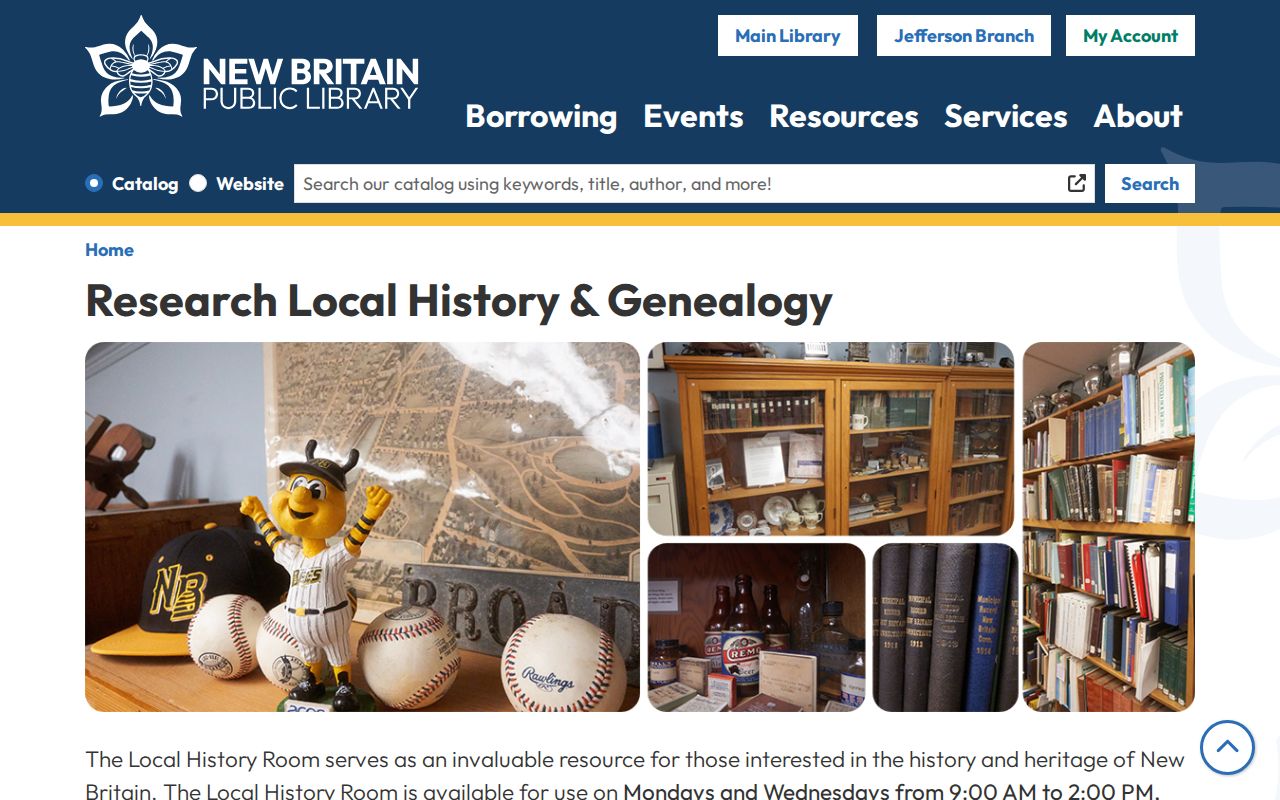
The library image places the local collection in its proper setting. Use the room for volume identification, page review, and help with a gap, then preserve the exact citation rather than reporting a loose name match.
New Britain Directory Years Located
The known runs show why a New Britain directory search needs a date ledger. FamilySearch has 18 microfilm reels with Price, Lee & Co. examples for 1882-85. The National Archives guide places New Britain in a 1928-31 city-directory reference. The regional Bridgeport holdings fill many later gaps, but they are physical holdings and should be confirmed before travel. These sources describe located coverage, not a complete continuous publication history.
The telephone scans add a second kind of historical snapshot. The Library of Congress has New Britain pages from November 1942 through November 1945, August 1958 through 1960/61, and 1964/65 through 1966/67. A telephone volume may show a subscriber, address, business, or number without proving that every member of a household lived there. Capture the volume date and page when a phone listing becomes a family-history lead.
- Use the FamilySearch New Britain catalog to identify the 18-reel trail and the Price, Lee & Co. examples.
- Use the regional holdings list to select a likely year, then confirm access with the Bridgeport History Center.
- Use the Library of Congress telephone scans for a dated address, phone, business, or abbreviation clue.
- Ask the New Britain library to resolve years that are not listed in a public catalog.
No exact final printed year was located in the inspected sources. That absence is useful: it prevents a researcher from turning a last-seen volume into a claim that publication stopped in a particular year.
Reading New Britain Directory Entries
A New Britain directory entry should be read as a compact, dated record. Begin with the surname and initials or with the street and house number. Then copy the printed spelling, the page, the volume year, and every abbreviation before trying to interpret the household. An entry can expose a street, telephone, business or occupation clue. It cannot by itself establish a deed transfer, a voter registration, or a current residence.
| Publication line | Year, publisher, volume, page, and whether the page is alphabetical, street order, or telephone order. |
|---|---|
| Name | Surname, initials, full name when printed, and spelling variants. |
| Spouse or household note | Parentheses, widow wording, or another household relationship exactly as printed. |
| Occupation or business | The trade, employer, company, or organization note attached to the person. |
| Address and phone | House number, street, apartment or room, telephone, and any residence or boarding abbreviation. |
| Owner or renter mark | Any tenure mark printed by that volume; use the volume key and do not assume a blank has meaning. |
- Criss-cross directory
- A reverse directory arranged by street address so a researcher can work from a location back to names, initials, or telephone entries.
- Householder index
- The alphabetical or household-level finding aid that points to a person or household entry; it is not the same as an ownership record.
- Abbreviation key
- The volume's explanation of short forms for occupations, relationships, residence, boarding, apartment, or business. Photograph or transcribe it before reading a page.
New Britain Reverse Directory Pages
The reverse side of the directory is especially useful when a family name is unknown. The Library of Congress criss-cross guide identifies New Britain examples for 1984 and 1985. Begin with a street and number, record the name or initials at that location, then move to the alphabetical section to test the spelling. The reverse entry is still a publication snapshot. It may reflect a phone subscriber or listed household, and it may omit people who did not appear in that type of volume.
Read the Library of Congress criss-cross directory guide before interpreting a street-order page. The guide helps distinguish a reverse address directory from an ordinary alphabetical directory. Compare the result with a deed or parcel record when a later address matters, and save both the street page and the name page so the direction of the search is clear.
The linked source capture explains the reverse-directory format used for the New Britain search. A street-first approach can reveal a neighbor, a business, or an alternate spelling that would not appear in a surname-only search.
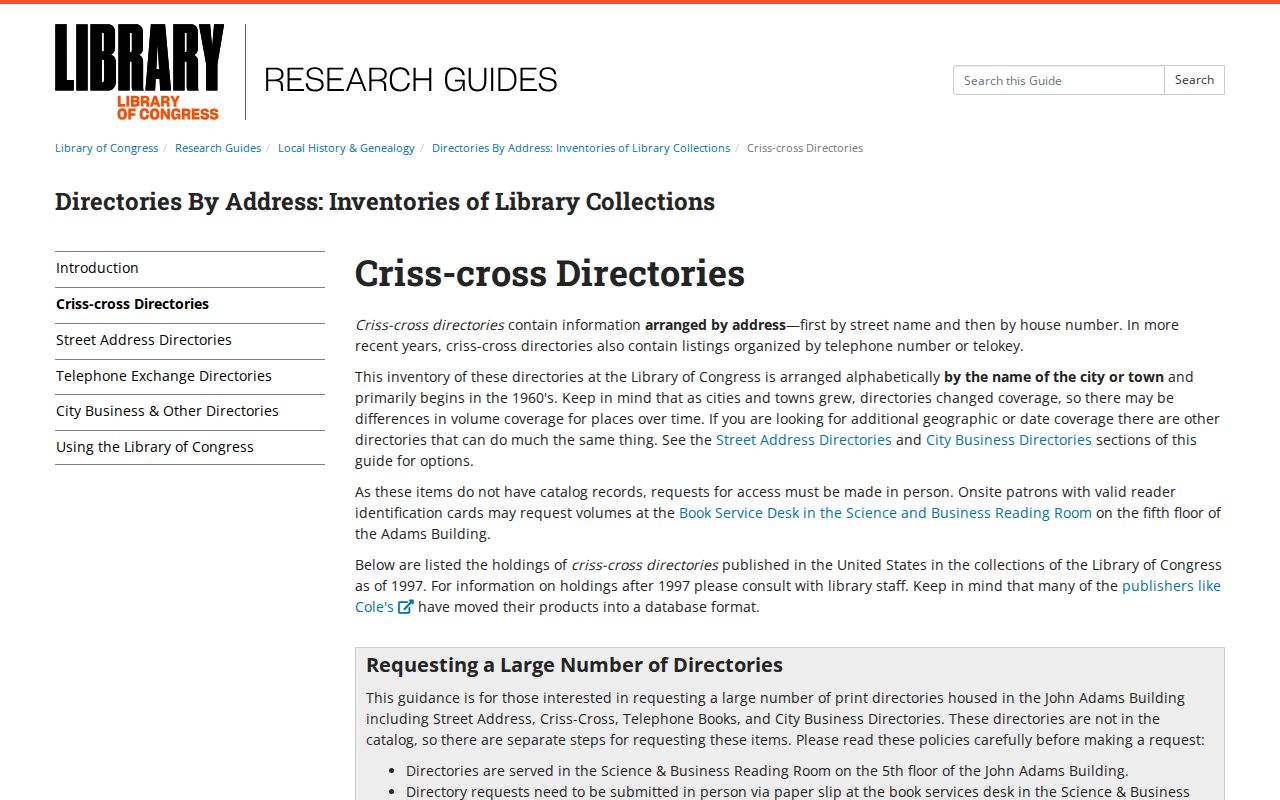
Use a reverse page to generate a lead, not a conclusion. The page date, street spelling, and exact number are the pieces that make the lead testable against another New Britain record.
New Britain Herald Directory Clues
The New Britain Herald and its related archives can fill the space between directory years. The library points researchers to Heritage Hub notices, the digital Herald, microfilm, and Chronicling America coverage for 1915-1930. Search a surname with a street, spouse, business, cemetery, or neighborhood term. If the digital result is thin, inspect the microfilm image. OCR can miss an initial or misread a Polish name, while the page image preserves the printed context.
The New Britain digitized newspaper and scrapbook collection is searchable and browseable by decade. Its Symonds Scrapbook covers 1901-1946 with 2,886 pages, the Burritt journals cover 1841-1864 and earlier, the Hanna Scrapbook covers 1901-1937 with 438 pages, and the Klingberg Scrapbook covers 1897-1905 with 150 pages. Preserve the collection title, date, page, image, and OCR confidence. A notice that names a street may give a move, death, business, or family connection that a directory alone cannot explain.
That obituary-to-address workflow is one of the most useful human paths in New Britain: start with a dated notice, compare its residence or relatives with a directory, then check Fairview or a vital record. The three sources can describe different moments, so label each fact as residence, death-time residence, interment, or family relationship.
Tracing New Britain Family History
A household trail becomes stronger when each directory year is paired with a record from a different system. Census schedules are public for 1790 through 1950 under the 72-year rule, while the 1960 census does not open until 2032. Census entries are household snapshots with names, ages, relationships, birthplaces, and sometimes ward or address context. They do not prove a current New Britain residence.
- Find the earliest directory entry that matches the name, street, spouse, business, or telephone clue, and save the full page citation.
- Follow the household through later directory years, noting every street spelling, number, apartment, occupation, and household relationship.
- Use the reverse or criss-cross pages to test who was listed at the address when a surname search misses the household.
- Pair each directory date with the closest available census year, searching New Britain by ward or district and recording the household members.
- Test the gaps with a New Britain Herald notice, deed, probate record, or cemetery result, and label the source's date and role.
A person disappearing from a directory may have moved, died, changed a name, stopped subscribing, or simply fallen outside that volume's coverage. A later newspaper, cemetery entry, probate file, or deed helps separate those possibilities. When a historical directory find needs a present-day cross-check, use the New Britain resident lookup workflow and keep the older publication in its historical role.
New Britain Directory Timeline
New Britain record history explains why directories, maps, deeds, and newspapers must be read together. The timeline below does not claim a complete publisher history. It marks verified points where a researcher can change tools or expect a different kind of evidence.
- 1850: The Town Clerk archive begins, and the historic land books later exposed through the HLR route start the local municipal trail.
- 1871: New Britain becomes a city, adding city-era context to later directory, newspaper, and municipal references.
- 1882-1885: FamilySearch catalog examples identify Price, Lee & Co. directory volumes across 18 microfilm reels.
- 1912: A Library of Congress New Britain street map supplies a period grid when a current street name does not match an older entry.
- 1942-1945: Library of Congress telephone scans provide wartime-era subscriber pages.
- 1958-1961 and 1964/65-1966/67: Later telephone scans extend the dated address and business trail.
- 1984-1985: Library of Congress criss-cross references show the reverse-directory method for New Britain addresses.
For a house-history question, record the directory year beside the deed date, census year, map year, and cemetery event. The result is a dated chain, not a single timeless label.
Fairview and Burritt in New Britain
Fairview Cemetery's search is a useful local companion to New Britain directories. Fairview began in 1756 and reports more than 38,000 interments. Its online fields include first and last name, born, died, and interred dates, cemetery section, block, lot, and veteran information. The city's staff-research description adds possible late residence, parents, maiden name, spouse, undertaker, and lot details for records reaching from the mid-1890s forward. A cemetery result can connect a former resident to a family or street, but it does not prove a current address.
New Britain's Burritt collections provide another human-use path. The public library holds Burritt journals and papers, CCSU's Elihu Burritt Library supplies special collections and Polish Heritage material, and the New Britain Industrial Museum preserves local industrial context. The New Britain Institute archive context describes donations from Stanley Works and other historic companies. Search Burritt, a company, a school connection, or an organization across the collections, then compare a dated page with the directory entry rather than merging every matching name.
For broader genealogy help, the Connecticut State Library History and Genealogy service offers census, directory, old-house, probate, and naturalization guidance. Off-site material may take time to retrieve. Save the collection title, call number, page image, and access date so another researcher can reproduce the trail.
View the CCSU library source capture for New Britain historical collections. It shows how Burritt, university, Polish Heritage, and industrial records can add context around a name found in a directory.
Use these local collections for family history, community memory, and dated address research. Keep the publication, archive, and cemetery roles separate when the evidence is summarized.